
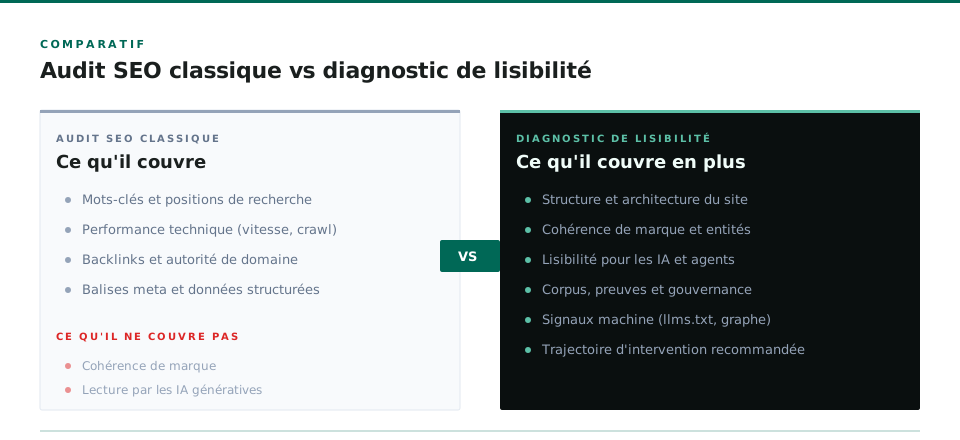
Two audits, two questions
A technical SEO audit and an agentic readiness audit can look similar from a distance. Both examine HTML, links, structure, performance, accessibility and selected machine signals.
But they do not answer the same question.
A technical SEO audit asks: can the site be crawled, understood, indexed and ranked by search engines?
An agentic readiness audit asks: can an agent understand the site, follow the right path and execute a task without critical ambiguity?
The difference may sound subtle. It changes the entire decision grid.
What technical SEO audits cover well
A strong technical SEO audit remains essential. It identifies issues that hurt discoverability and indexation:
- pages blocked by
robots.txtornoindex; - canonical errors;
- weak internal linking;
- incomplete sitemaps;
- orphan pages;
- excessive load time;
- missing or invalid structured data;
- duplicated content;
- incoherent page architecture;
- rendering errors that prevent engines from retrieving content.
These issues matter. A technically weak site will remain hard to find even if it is well written.
But the technical SEO audit often stops at the threshold of use. It verifies that the page exists, can be crawled, contains useful signals and may be indexed. It does not always verify whether an agent can act correctly inside the interface.
What an agentic audit adds
An agentic readiness audit adds an execution layer.
It is no longer only about whether a page can be read. It is about whether a system can use the page to complete a task.
That requires different questions:
- is the primary CTA available in the initial HTML?
- is the button a real interactive element?
- does the accessible name describe the real action?
- does the form connect labels, errors and confirmations properly?
- do visual rendering, DOM and accessibility tree tell the same story?
- do components remain stable between loading, hydration and interaction?
- does a card, offer or product connect each action to the right context?
- does the agent know what to do after an error, confirmation or redirect?
These questions are rarely covered deeply by a classic SEO audit.
Concrete example
Take a B2B service page.
From an SEO standpoint, the page may be correct: clear title, meta description, long content, structured data, internal links, sitemap presence and acceptable performance.
From an agentic standpoint, it may still fail:
- several CTAs use the same “Learn more” label without context;
- the form is injected late by JavaScript;
- form errors are not connected to fields;
- client proof is separated from the offer it supports;
- a modal blocks navigation without a clear accessible role;
- the page contains three similar services without a decision hierarchy.
The search engine can index the page. The agent may choose the wrong path, misqualify the offer or fail during action.
Why the distinction becomes strategic
Search engines rank resources. Agents use environments.
That sentence captures the shift.
As long as the website was mainly a document to retrieve, the technical SEO audit framed a large part of the risk. When the website becomes an interface that systems may manipulate, an operational reliability layer is needed.
This is especially true for B2B sites: appointment requests, diagnostic forms, service comparisons, qualification journeys, downloadable resources, proof pages, product documentation, pricing, filters and interactive modules.
What Pagup recommends
The right approach is not to replace technical SEO with an agentic audit.
The right sequence is:
- verify discoverability and SEO foundations;
- stabilize pages, corpus and proof;
- audit critical journeys for agentic use;
- fix components, forms, CTAs and unstable states;
- document machine surfaces such as
llms.txt,ai-manifest.jsonand policies; - install governance to prevent regressions.
This is why Pagup connects the Agentic Readiness Audit to the Strategic Digital Readability Diagnostic. One verifies action. The other frames the complete system.
Conclusion
A technical SEO audit tells whether a site is crawlable and readable by search engines.
An agentic readiness audit tells whether the site is usable by agents.
The two dimensions reinforce each other. But confusing them creates a false sense of safety. A website can be technically clean, well indexed, even visible in some AI answers, and still fragile when an agent must act.
Finding our insights useful?
Add to my Google sources