

Why this proof matters
The word governance is often used without any visible object behind it. Here, the proof must show the opposite: published surfaces, reading rules, coherent signals and a logic that connects these elements to real problems.
What one should be able to see
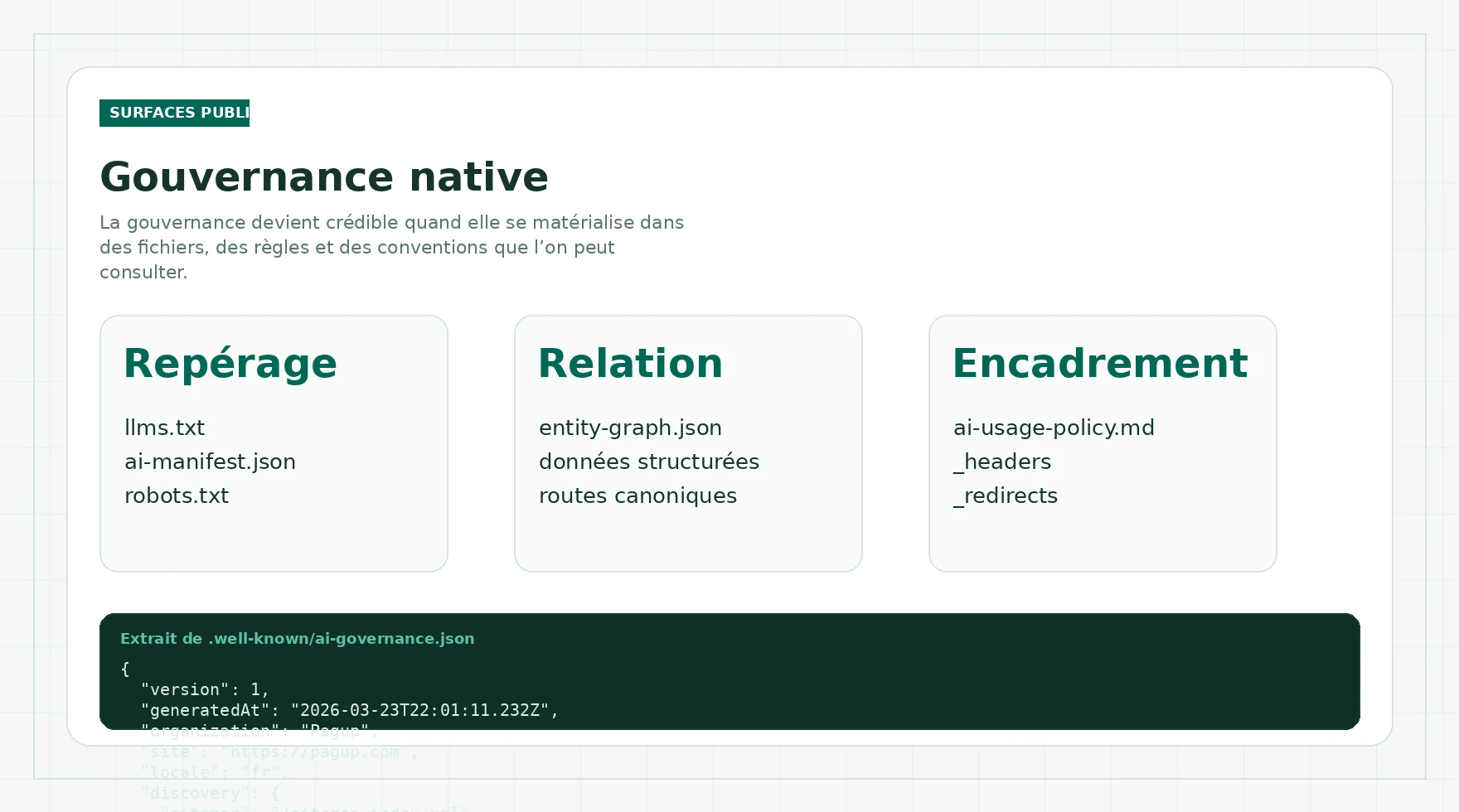
This proof must make inspectable:
- the published artefacts;
- their role in the system;
- the way they complement one another;
- what they concretely change in overall readability.
Interpretive governance becomes credible from the moment it materializes in readable objects, not solely in a methodological discourse.
The surfaces to show
Depending on the context, this may include:
llms.txt;ai-manifest.json;- an entity graph;
- an AI usage policy;
- certain structuring or URL conventions.
What matters is not accumulating files. What matters is that they extend a clear architecture and reduce real contradictions.
What a reader should understand
Sound governance does not exist to “look technical.” It exists to make reading more stable.
An executive should be able to understand that the organisation no longer depends solely on a good home page or a good sales copy. It also relies on a layer of structure and signals that helps systems read more accurately.
What you can verify yourself
Every element of this proof is publicly accessible. Here is how to inspect it:
- Open this site’s machine artefacts: access
/llms.txtand/ai-manifest.jsonfrom your browser. Read them. They describe the offering, the services and the relationships between entities in a structured format, not in marketing copy. - Compare the description with its sources: record accurate statements, omissions and errors in an AI answer. A faithful description is a useful observation. It does not by itself establish that published machine-readable surfaces caused that fidelity. A causal claim requires an appropriate comparative protocol.
- Verify the standard: the normative framework is published on interpretive-governance.org. Versioned definitions, interpretation policies and output constraints are accessible to anyone.
- Explore the doctrine: on gautierdorval.com, a corpus of articles document the principles. The canonical definitions are versioned and traceable.
What to remember
This proof shows that serious interpretive governance is neither decorative nor theoretical. It is published, verifiable and connected to the rest of the site. The AI governance and machine readability service describes how this same logic is deployed for client organisations.
Multi-property deployment
The interpretive governance of our ecosystem materializes across three properties, each with its specific artefacts:
- pagup.com: commercial site with published machine surfaces (
llms.txt,ai-manifest.json, entity graph, AI usage policy), content architecture driven by Zod collections and inspectable proof; - gautierdorval.com: doctrine and observation, with a corpus of articles, versioned canonical definitions, structured corpus connecting interpretive governance, interpretive risk and semantic architecture;
- interpretive-governance.org: formal normative framework of interpretive governance, with interpretation policy, output constraints, doctrinal index, AI policies and verifiable machine-first artefacts.
Evidence scope
PAGUP’s surfaces support inspection of publication, reference consistency and their relationships. This evidence does not establish runtime behavior on GautierDorval.com or a client deployment. Each interaction needs evaluation within its own scope. Publishing rules alone does not demonstrate their application by an agent.
Finding our insights useful?
Add to my Google sources