
The underlying shift
Technical SEO has long been dominated by one question: can search engines discover, crawl, understand and index the page?
That question still matters. But it is no longer sufficient.
With AI agents, a new layer appears: can an autonomous system understand the interface, choose an action and execute it correctly?
Google already frames this shift in its Build agent-friendly websites documentation. Agents are described as a new type of visitor capable of interpreting, planning and executing actions. This is not merely an extension of crawling. It changes the role of the website.
A site is no longer only a document to index. It becomes an environment to operate.
The third reader of the web
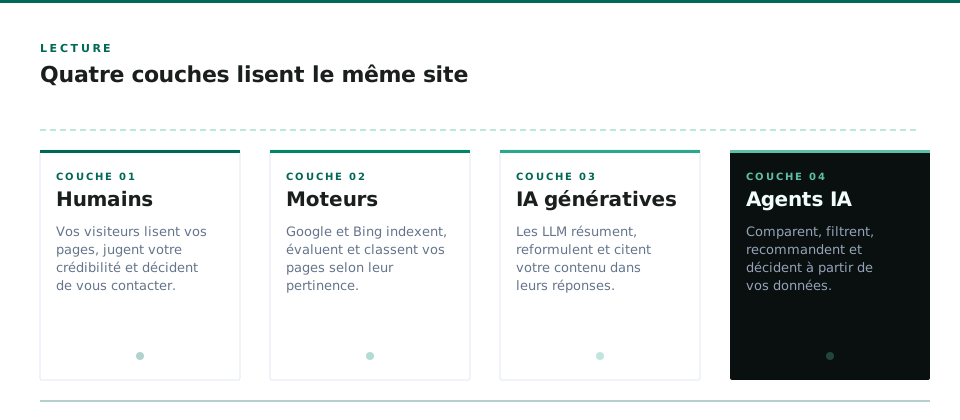
For years, we designed sites for two audiences: humans and search engines.
A third reader now has to be added: the agent.
A human visitor reads, compensates and interprets. They can infer that a fake button is clickable because it looks like a button. They can look elsewhere if a form is confusing.
A search engine crawls, extracts, ranks and indexes. It cares about document structure, links, content, technical signals and entities.
An agent sits between the two. It sees like a user, reads like a machine and acts like an operator. It can analyze a screenshot, read the DOM, inspect the accessibility tree, then click, fill, filter or submit.
That combination is what makes the agentic web demanding.
Interfaces must become interpretable
An interpretable interface is not merely attractive. It clearly expresses what it allows the user or agent to do.
That requires:
- buttons that are real
<button>elements; - links that are real
<a>elements; - forms whose fields have connected labels;
- actions named by their real intent;
- coherent visual hierarchy;
- stability between loading, hydration and interaction;
- an accessibility tree that accurately reflects the interface.
None of these practices are new. What changes is their strategic role. They no longer serve only human accessibility or frontend quality. They also become signals of agentic navigability.
The trap of opaque components
Many modern sites have accumulated components that look polished but remain semantically weak.
A button is sometimes a styled <div>. An entire card is clickable without a clear signal. A field has a placeholder but no label. An action depends on a JavaScript state that arrives too late. A modal looks obvious visually but is unclear in the accessibility tree.
For a sighted human, these issues may be tolerable. For assistive technology, they are already a problem. For an agent, they create operational ambiguity.
The agent is not only trying to read. It is trying to act.
Why Astro and machine-first architecture are well positioned
A restrained, server-rendered architecture with controlled hydration fits this logic better than an interface that depends entirely on late client-side state.
This does not mean JavaScript frameworks are bad by nature. It means the question becomes sharper: are critical content and actions available, named and stable before client enrichment?
That is one of the advantages of a well-designed machine-first website architecture. It treats HTML as a surface of truth, not as a temporary shell waiting for JavaScript.
What teams should audit
In the short term, teams should examine four dimensions:
- Multimodal coherence: do what humans see, what the DOM exposes and what the accessibility tree describes tell the same story?
- Action semantics: are buttons, links, fields and interactive states properly named and coded?
- Stability: do critical elements remain in place between loading, hydration and interaction?
- Determinism: does an action produce a clear, predictable and readable result?
This is the foundation of the agentic readiness audit.
What to avoid
The market will probably reduce this topic to recipes: add a llms.txt, fix two ARIA attributes, follow a Lighthouse score or declare the site “AI-ready”.
That would be a mistake.
Agentic readiness is not a file. It is a property of the system: architecture, content, interface, accessibility, stability, structured data and governance.
Making a site actionable for agents does not resolve which identity they use inside WordPress. PAGUP Agent Control addresses that separate boundary.
Conclusion
Technical SEO made pages discoverable and understandable. The agentic web requires one more step: making interfaces actionable.
Organizations that treat this as another AI trend will lag behind. Those that treat it as a web architecture problem will gain a clearer advantage: sites that are more restrained, more accessible, more stable and more useful for every reader of the web.
Finding our insights useful?
Add to my Google sources