
Why this piece exists
The market still names the problems this site actually addresses poorly. An organisation says it wants more SEO, a better redesign, more visibility in AI responses, a clearer brand, more useful documentation, or a more stable presence. These formulations are not wrong. They are simply incomplete.
The commercial thesis exists to ask the more accurate question: what prevents a digital presence from being correctly understood, reused and recommended by the right readers?
The shift that justifies the offering
A site is no longer read by a single layer. It is read by humans, by search engines, by generative systems and, increasingly, by agents that must compare, choose or recommend based on public traces.
This changes everything. An organisation can still publish, still rank, still produce content, and nevertheless remain misunderstood. It can be visible without being clear. It can be cited without being well described. It may even have invested in a redesign without having rebuilt what truly matters: the architecture of comprehension.
Pagup groups this change in the nature of the Web under the expression “digital readability and agentic readiness”: a digital presence’s capacity to be correctly understood, then used, by all its human and non-human readers.
What the thesis avoids
The commercial thesis avoids two opposite errors.
The first consists of reducing the entire subject to expanded SEO. SEO remains important, but it no longer suffices to describe the full set of problems around structure, proof, interpretive governance and machine readability.
The second consists of speaking only with methodological vocabulary. If the discourse becomes too abstract, it loses the person who is simply trying to understand why their site no longer helps the business enough.
What it makes possible
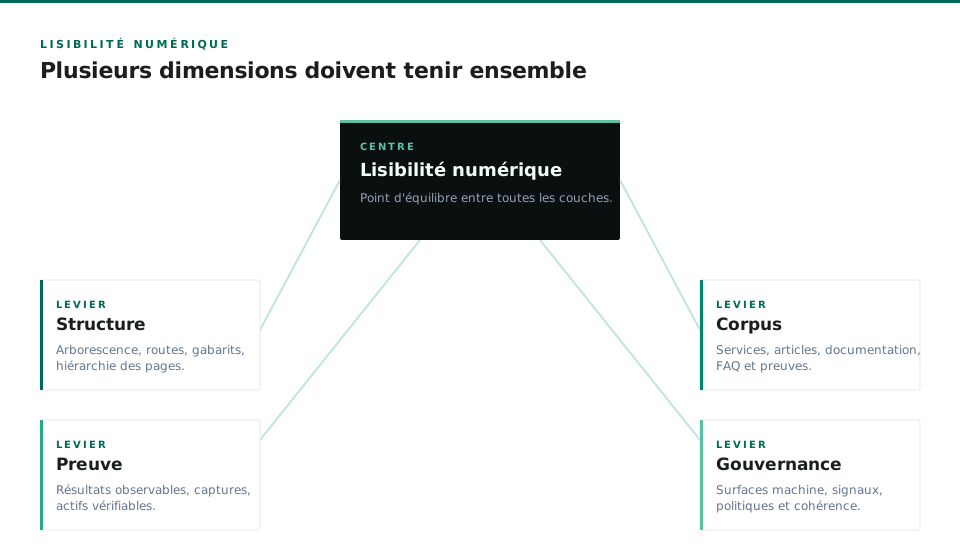
This thesis holds together problems that, at first glance, appear separate:
- fragile organic traffic, a sign of fragile visibility in search engines and AI;
- a redesign that did not fix anything;
- a brand that is often poorly reformulated;
- a corpus that is too scattered;
- approximate generative answers;
- rich but poorly readable documentation;
- proof that is too weak or misplaced.
Instead of treating each symptom as a silo, the thesis connects them to the same question: is the site genuinely readable, credible and governed as an asset?
What an organisation actually buys
Most organisations do not buy a concept. They are looking for four things:
- understanding what is truly blocking them;
- avoiding a poorly framed workstream;
- rebuilding what needs to be rebuilt without waste;
- obtaining a more readable and more robust digital presence.
The commercial thesis exists precisely to transform these diffuse expectations into an intelligible offering.
Contexts where this page becomes useful
This page is particularly helpful for:
- an executive who senses that the site no longer reflects the real value of the company;
- a marketing lead who sees activity, but little clear comprehension;
- a software publisher whose product, documentation and content no longer tell the same story;
- a professional firm whose expertise exists, but remains too vague externally;
- a personal brand or highly visible organisation that no longer controls how it is being re-read.
In practice: what this changes for you
Consider a concrete example. An engineering consulting firm has a 200-page site. The content is dense, the expertise is real, organic traffic exists. Yet, when a decision-maker asks an AI system to compare three similar firms, the firm in question is described as “a technical services company.” No differentiating expertise surfaces. No proof appears.
The problem lies neither in content volume nor in classical search engine optimisation. It lies in the fact that the site structure does not allow readers (human or machine) to understand what genuinely distinguishes this firm from the others. The commercial thesis exists precisely to name this type of gap and to direct the intervention toward the right layer: here, a content architecture coupled with a brand disambiguation.
What to remember
The commercial thesis does not exist to theorize for its own sake. It exists to remind us that a site can be technically correct and commercially weak, editorially dense and structurally unreadable, or visible without being correctly interpreted.
The work begins precisely there: when the experienced problem, the actual structure, inspectable proof and interpretive governance must be connected within a single intervention logic. The strategic diagnostic is the natural entry point for this approach. To better understand the layers of reading at play, consult the digital readability model.