
What this model is for
The digital readability model exists to answer a simple question: what does a site actually allow people to understand, for whom, and under what conditions?
Many teams still judge a site based on a single criterion: design, SEO, speed or editorial quality. Each of these criteria matters, but none suffices on its own. A site can be beautiful and poorly understood. It can rank and convert poorly. It can be dense and remain unusable for machine reading.
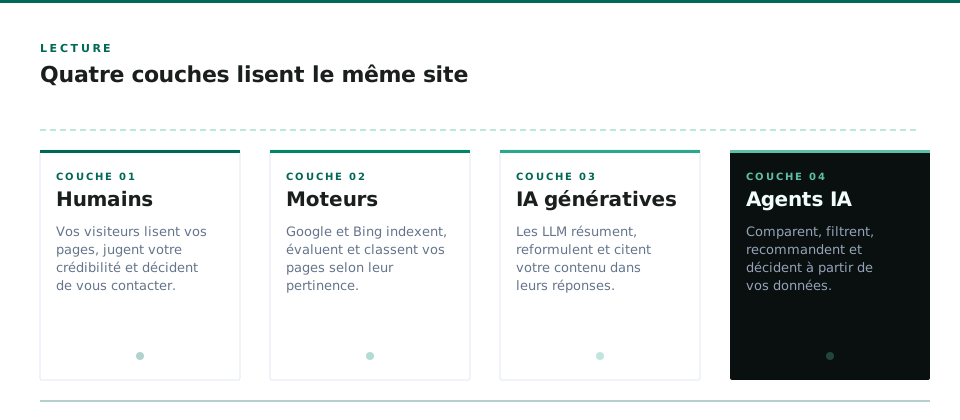
The four reading layers
1. The human layer
This is the layer of immediate comprehension: clarity of the offering, hierarchy, credibility, ability to navigate, quality of important pages and readability of proof.
2. The engine layer
This layer concerns indexation, interlinking, structure, editorial conventions, structured data and the way pages relate to one another.
3. The generative layer
This is where AI systems reformulate, compare, summarize or respond based on your public traces. Here, a site can be visible yet remain too vague to be correctly described.
4. The agentic layer
Autonomous agents discover resources, plan a journey, navigate, select an option, act and interpret the result. This layer verifies that a correct representation can become a reliable path without critical ambiguity between visual rendering, HTML, the DOM, the accessibility tree and interface states.
Cross-layer outcomes
Discovery, understanding, representation, recommendation, decision and action are not reader categories. They are outcomes that cut across the four layers. A human decision may depend on a search engine or a generative summary. An agentic action depends on correct understanding and a reliable journey.
The model therefore identifies who reads the site, then verifies whether the expected outcomes remain coherent from one layer to another.
What the model changes in an engagement
This model prevents treating an isolated symptom as though it explained everything.
A drop in visibility may come from weak structure. An imprecise generative answer may come from an ambiguous brand. A failed redesign may come from too thin a corpus. Documentation that is abundant may remain useless because it does not connect the offering, the proof and the use cases.
The model therefore helps decide whether the right workstream involves:
- a light correction;
- a machine-first redesign;
- a content architecture;
- a disambiguation;
- deeper interpretive governance.
Concrete example
Consider a B2B software publisher that owns several products, rich documentation, a few case studies and articles published over a long period. Search engines find certain pages, but demo requests remain weak and generative systems summarize the company in overly general terms.
The problem is not necessarily the absence of content. It may stem from an accumulation of poorly connected layers: product pages that are too similar, documentation without clear hierarchy, proof that is insufficiently visible, poorly stabilized entities and inadequate machine signals.
By applying the model, one discovers that the human layer works correctly (visitors understand the offering), but the engine layer suffers from cannibalization between product pages, the generative layer lacks structured data to distinguish products from one another, and the agentic layer exposes no reliable journey between documentation, offer selection and conversion. The strategic diagnostic maps these imbalances layer by layer before deciding where to intervene.
What to remember
The digital readability model does not exist to add a theoretical layer. It exists to read a site more accurately and to avoid false remedies.
When the four layers stop contradicting one another, digital readability becomes more stable, more credible and more useful for humans, search engines, generative systems and autonomous agents. Agentic readability specifies the requirements of this fourth layer. The transformation sequence then shows the order in which to intervene.