
Why the order matters as much as the work itself
Many organisations move too quickly toward a visible deliverable. They request a redesign before having clarified the problem, content production before having structured the corpus, or an “AI” layer before having stabilized the foundation.
The result is well known: money is spent, content is published, things are redone, and then the team realizes the site remains difficult to understand or to maintain.
The useful sequence
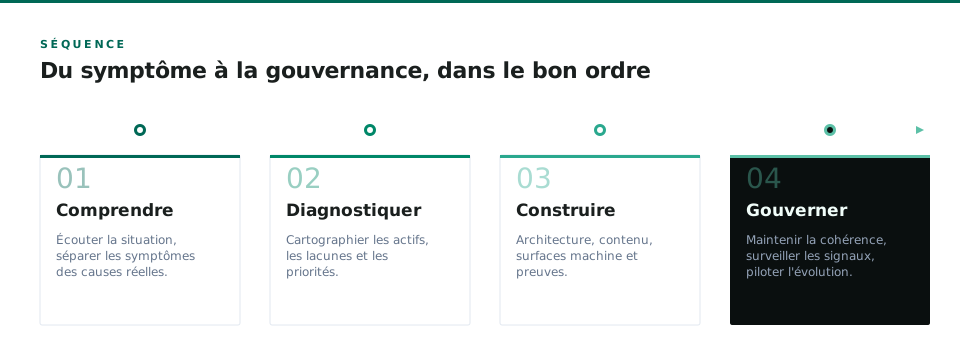
1. Clarify
Start from what is experienced: symptoms, constraints, context, history, assets already available and degree of maturity.
2. Diagnose
Read the actual structure: offering hierarchy, corpus, proof, brand, signals, documentation, machine surfaces and zones of contradiction. This step includes a semantic calibration to align public vocabulary with the real offering.
3. Deploy
Then build the assets that truly serve: machine-first redesign, content architecture, disambiguation, proof pages, documentation, governance surfaces, interlinking rules and editorial components.
4. Govern
Measure, stabilize, maintain. Without interpretive governance, the transformation degrades quickly, especially when multiple teams republish and reorganize over time.
What this sequence changes
It protects the budget. It also protects the quality of the outcome.
For a consulting firm, it avoids redoing pages without clarifying expertise and proof. For a software publisher, it avoids producing more documentation before having resolved the hierarchy between product, documentation and conversion. For a personal brand, it avoids publishing more before having stabilized the reading of the entity itself.
In practice: an application case
A non-profit organisation in the public health sector owns three legacy sites, some thirty publications and a resource directory. The executive director requests “a redesign of the main site.”
By following the sequence, one discovers during the clarification step that the real issue is not the visual redesign, but the confusion between the three properties. During the diagnostic step, overlaps are mapped: the same topics are covered on two different sites, impact proof is scattered, and search engines index contradictory pages.
Deployment then begins with a consolidation of canonical surfaces and a unified content architecture, before touching the design. Without the sequence, the organisation would have spent its budget on a visual redesign that would not have resolved the underlying problem.
What to remember
A sound transformation does not begin with the most visible deliverable. It begins with the right order. That is what produces a more readable, more credible and more durable digital presence. To see how this sequential logic materializes in concrete results, consult the trajectories and observable results. The digital readability model provides the reading framework that feeds each step.