
What this proof must show
This proof does not exist to say that a site is “clean” or “modern.” It exists to show that a site can be designed as a complete reading system.
One should be able to see:
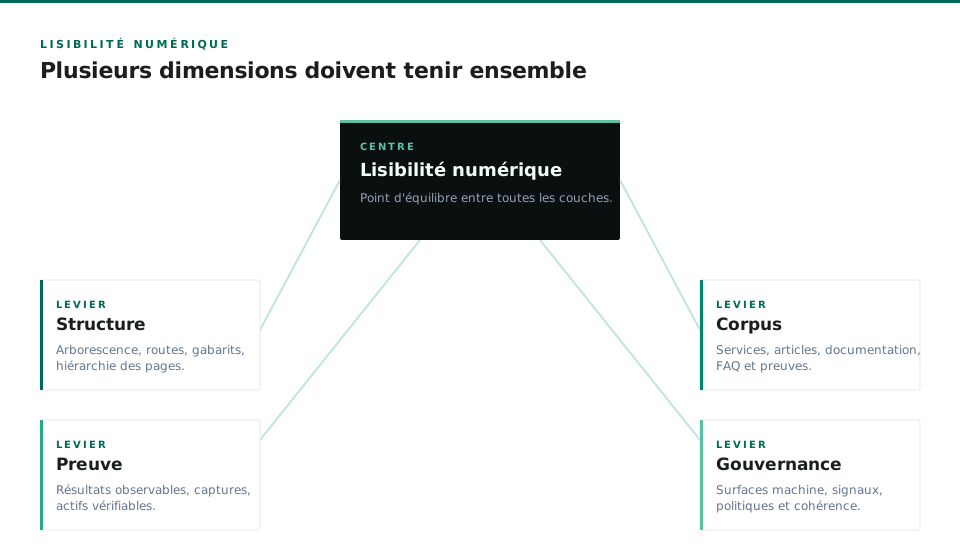
- a clear hierarchy among services, sectors, issues, proof and conversion;
- machine surfaces that are actually published;
- an editorial corpus that is organized rather than piled up;
- coherence between visible pages, signals and interpretive governance;
- a foundation stable enough to be useful to humans, search engines and AI systems, a direct application of the machine-first approach.
What a serious buyer should be able to inspect
The proof must be concrete. A serious person should be able to open the site, see the architecture, spot the published surfaces, understand the role of the hubs, read the service pages and confirm that the whole does not depend solely on well-written copy.
The most useful captures are typically:
- proof and conversion routes;
- machine surfaces such as
llms.txt,ai-manifest.jsonor the entity graph; - the organization among hubs, service pages, sectors and proof;
- a structural before/after comparison when it exists.
What this proof provides
It allows for quick verification of three things:
- the site can maintain a clear structure;
- the machine layers are published coherently;
- the proof is integrated into the system, not separated from the rest.
Why this is more useful than a simple portfolio
A portfolio often shows the visual result of a project. This proof shows the construction logic itself. That is what matters when discussing machine-first redesign, content architecture or interpretive governance.
What you can verify yourself
To judge this proof, you need only a browser and a few minutes:
- Inspect the page architecture: navigate through services, symptoms and proof. Observe how each page links back to the others coherently, not by simple interlinking convention, but because relationships are defined in the site’s structured data.
- Consult the machine surfaces: access
/llms.txtand/ai-manifest.jsonfrom your browser. These files are not placeholders. They describe the entire offering in a format that AI systems can consume directly. - Compare with a conventional site: open any competitor site and look for the same artefacts. The absence of these surfaces illustrates the difference between a site that hopes to be understood and a site that organizes its own reading.
- Verify the ecosystem coherence: visit gautierdorval.com for the doctrine, interpretive-governance.org for the formal standard. Each property carries a distinct mandate, but the reading remains coherent.
What to remember
The best proof is not a slogan. It is a site that allows one to observe, in a few minutes, that the structure, the proof, the machine surfaces and the governance already hold together. The digital readability model describes the four layers that this site seeks to satisfy simultaneously.