
Why this proof is useful
Technical proof shows artefacts. Services show possible interventions. What is often missing is an intermediate space: what does a readable transformation actually look like in the real world?
That is what this page is for.
The logic to show
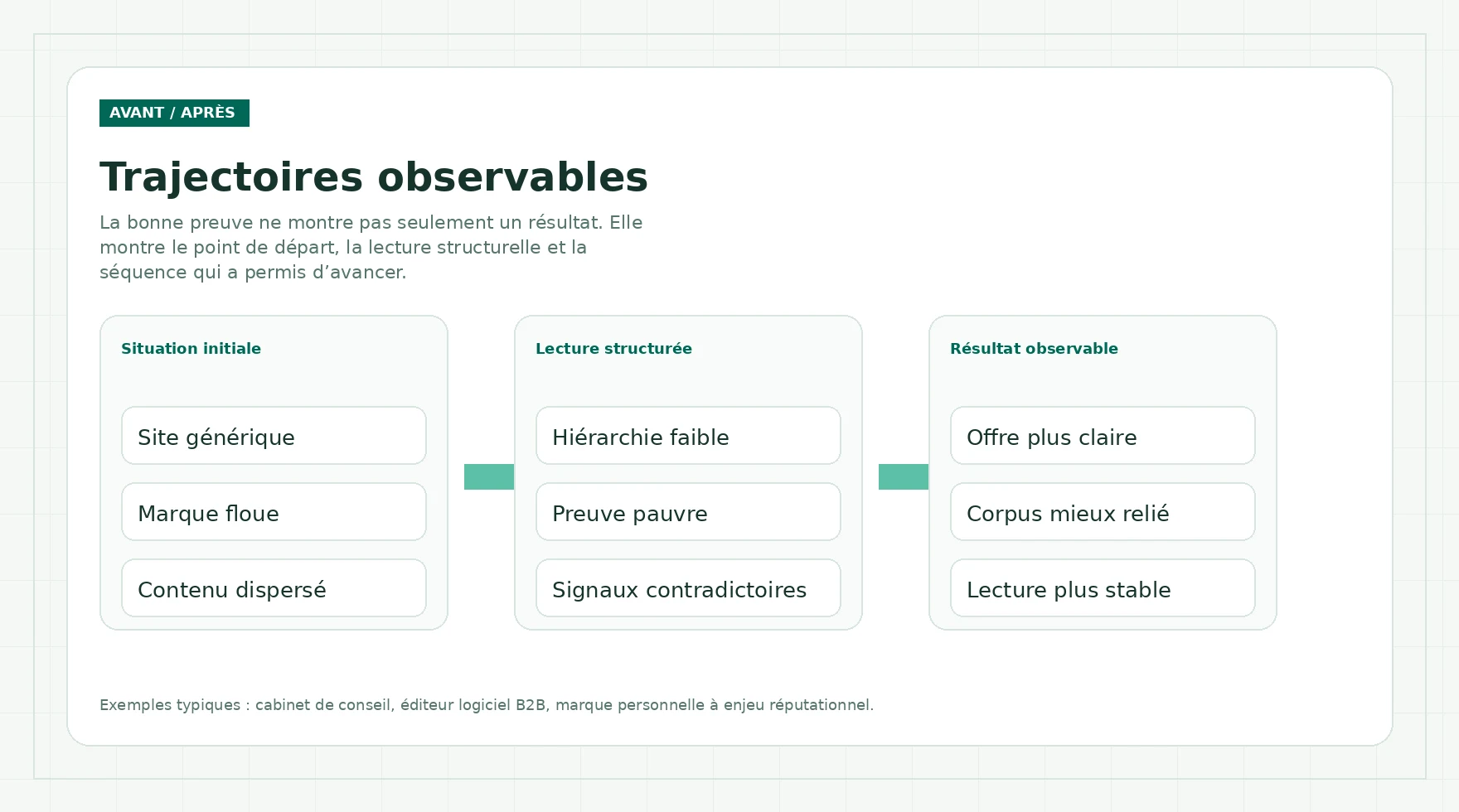
A credible trajectory always follows the same progression:
- a clear starting situation;
- a structural reading of the problem;
- a realistic intervention sequence;
- an observable result.
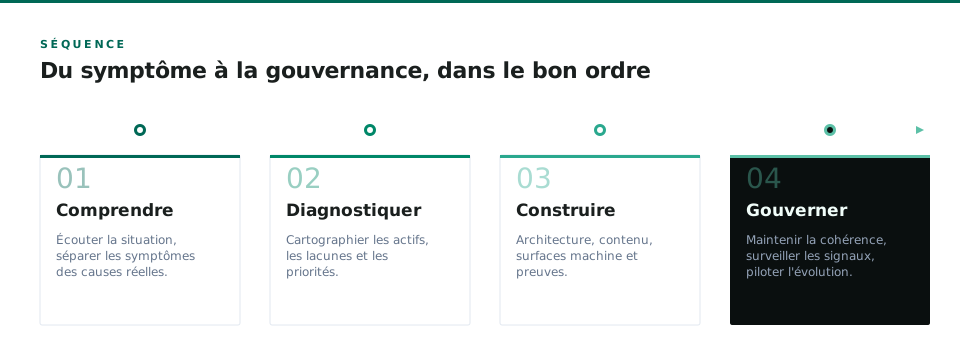
The observable result is not necessarily a spectacular number. It may be a better understanding of the offering, documentation finally connected to the product, a more stable brand, a healthier architecture or a less confusing generative answer. This is the logic of the transformation sequence put into practice.
Three typical trajectories
Consulting firm
Before: real expertise, overly generic pages, poorly structured offerings, little visible proof. Intervention: diagnostic, service clarification, proof surfacing, sector pages, better articulation between doctrine, conversion and expertise. Observable result: clearer reading of the offering and more stable brand.
B2B software publisher
Before: rich but scattered documentation; product pages too similar; use cases and proof poorly connected. Intervention: content architecture, documentation hierarchy, product proof, more coherent machine surfaces. Observable result: more intelligible corpus and better articulation between product, documentation and discovery.
Organisation with complex assets
Before: multiple domains, multiple histories, contradictory messages. Intervention: mapping, arbitration of canonical surfaces, redirections, brand clarification, interpretive governance. Observable result: more stable reading of the whole and less noise between assets.
What you can verify yourself
You do not need to take our word for it. Here is what you can inspect directly:
- The structure of this site: open pagup.com and observe how services, symptoms, proof and sectors are connected to one another. Each service page links to specific symptoms and verifiable proof.
- The published machine surfaces: consult artefacts such as
llms.txtorai-manifest.jsonto confirm that the machine layer is not a sales argument but a set of objects actually published. - The doctrine on gautierdorval.com: more than 400 articles document the thinking that underpins these trajectories. You can read the canonical definitions and verify the coherence between doctrine and execution.
- The standard on interpretive-governance.org: the formal normative framework is published on interpretive-governance.org, independently of any commercial activity.
What to remember
A useful trajectory does not need to exaggerate. It simply needs to show that a problem formulated at the outset can be read more accurately, treated in the right order and produce a visible result. The transformation sequence details the work order that produces these trajectories.